
Budget 2026: Finance Minister Nirmala Sitharaman Unveils 7 New High-Speed Rail Corridors Making Chennai a Key Hub

India's infrastructure story took a major leap forward in the Union Budget 2026–27. In a bold and future-focused announcement, the Union Minister of Finance & Corporate Affairs, Nirmala Sitharaman, unveiled plans for seven brand-new high-speed rail corridors, spanning nearly 4,000 kilometres with an estimated investment of ₹16 lakh crore.
What makes this announcement especially significant is Chennai's central role. The city is positioned as a major southern anchor, connecting multiple economic and industrial hubs through high-speed rail—clearly signaling its rise as a national growth engine.
Seven High-Speed Rail Corridors: Growth Connectors Between Cities
These corridors are not just transport projects. They are designed as "growth connectors"—linking financial centres, industrial zones, IT corridors, ports, and fast-growing urban regions.
Proposed High-Speed Rail Corridors
| Corridor Route -Key Cities Connected | Strategic Importance |
|---|---|
| Chennai – Bengaluru | Links two major southern economic and tech hubs |
| Hyderabad – Chennai | Strengthens IT, manufacturing, and port connectivity |
| Mumbai – Pune | Supports India's financial capital and industrial belt |
| Pune – Hyderabad | Enhances western–southern industrial movement |
| Hyderabad – Bengaluru | Connects major IT and startup ecosystems |
| Delhi – Varanasi | Boosts cultural, tourism, and economic travel |
| Varanasi – Siliguri | Improves access to eastern and northeastern India |
Together, these routes aim to cut travel time drastically, improve workforce mobility, and unlock new regional investment opportunities.
Why Chennai Takes Centre Stage
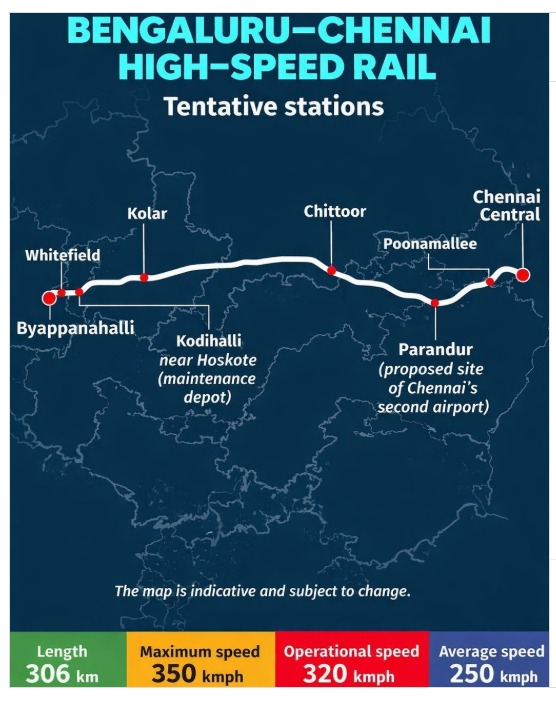 Among all cities, Chennai stands out with two major high-speed rail links:
- Chennai–Bengaluru
- Hyderabad–Chennai
This positions Chennai as:
- A southern logistics and mobility hub
- A key connector between IT corridors, manufacturing clusters, ports, and airports
- A catalyst for real estate, industrial parks, and township development along these routes
For investors and businesses, Chennai's enhanced connectivity means faster access to talent, markets, and infrastructure.
What Exactly Is a Rail Corridor?
A rail corridor is a dedicated transportation route designed to move passengers or goods efficiently between specific regions. Unlike regular railway lines, corridors are:
- Strategically planned for high traffic demand
- Integrated with urban transit, highways, ports, and airports
- Built to support long-term economic and regional growth
Rail corridors often trigger development of:
- Industrial zones
- Warehousing hubs
- Residential townships
- Commercial and logistics parks
What Makes High-Speed Rail Corridors Different?
High-speed rail corridors take this concept to the next level.
Key Features of High-Speed Rail Corridors
| Feature | High-Speed Rail |
|---|---|
| Train Speed | Typically 250–350 km/h |
| Travel Time | Reduced by 50–70% |
| Track Design | Dedicated, fully fenced lines |
| Safety | Advanced signaling and control systems |
| Economic Impact | Strong boost to real estate, jobs, and regional growth |
These corridors are designed for fast, reliable, and high-capacity passenger movement, making same-day inter-city commuting a reality.
Implementation & Execution
The proposed high-speed rail projects are expected to be implemented by National High-Speed Rail Corporation Limited (NHSRCL), the agency already responsible for India’s flagship bullet train initiatives.
The focus will be on:
- World-class rail technology
- Faster passenger systems
- Sustainable and future-ready infrastructure<
This announcement aligns with the broader infrastructure push in Budget 2026–27 to accelerate economic growth and strengthen national connectivity.
What This Means for Real Estate & Investment
History shows that major transport corridors transform land value. Areas near high-speed rail routes typically witness:
- Rapid appreciation in land prices
- Demand for plotted developments and townships
- Growth in commercial and industrial real estate
As Chennai, Bengaluru, Hyderabad, Pune, and key northern cities become more closely connected, real estate along these corridors becomes a strategic long-term investment.
In this context, Wisdom Properties plays a crucial role by offering DTCP-approved plots near emerging growth corridors and connectivity hotspots. With infrastructure projects like high-speed rail shaping the future, plots near these locations are positioned not just as land purchases—but as smart, future-ready investments.
Union Budget 2026 High-Speed Rail Corridor FAQs
1. What is the main objective of the new high-speed rail corridors announced in Budget 2026?
The primary objective is to improve fast inter-city connectivity between major economic, industrial, and population centres. These corridors aim to reduce travel time, support business mobility, strengthen regional economies, and promote balanced urban growth across India.
2. Why is Chennai considered a major hub in the new high-speed rail plan?
Chennai is connected through two key corridors—Chennai–Bengaluru and Hyderabad–Chennai—making it a central southern node. This strengthens its role as a link between IT hubs, manufacturing zones, ports, and emerging industrial regions, boosting its economic importance.
3. How are high-speed rail corridors different from regular railway lines?
High-speed rail corridors use dedicated tracks designed for very fast trains, usually operating at speeds above 250 km/h. They feature advanced safety systems, modern signaling, and significantly reduce travel time compared to conventional railways.
4. Who will implement these high-speed rail corridor projects?
The projects are expected to be implemented by the National High-Speed Rail Corporation Limited (NHSRCL), which is responsible for developing high-speed passenger rail systems across India.
5. How will high-speed rail corridors impact real estate and land investment?
High-speed rail corridors often lead to increased land demand and price appreciation in nearby areas. Improved connectivity attracts industries, residential projects, and commercial developments. As a result, Wisdom Properties focuses on offering DTCP-approved plots near such high-growth connectivity corridors, helping investors benefit from long-term infrastructure-driven development.
Latest Blogs




PROJECTS IN NEARBY LOCATIONS
- Residential Plots in Guduvanchery
- Residential Plots in Singaperumal Koil
- Residential Plots in Chengalpet
- Residential Plots in Walajabad
- Residential Plots in Kanchipuram
- Residential Plots in Sunguvarchatram
- Residential Plots in Urapakkam
- Residential Plots in Sriperumbudur
- Property For Sale in Maraimalai Nagar
- Plots in Chennai
- Plots/Land for sale in Chennai
- Villas For Sale in Maraimalai Nagar
- DTCP Approved Plots Sale in Sriperumbudur
- Land for sale in Guduvanchery
- Gated Community Plots Sale in Guduvanchery
- Land for Sale in Nellikuppam
Post Comment